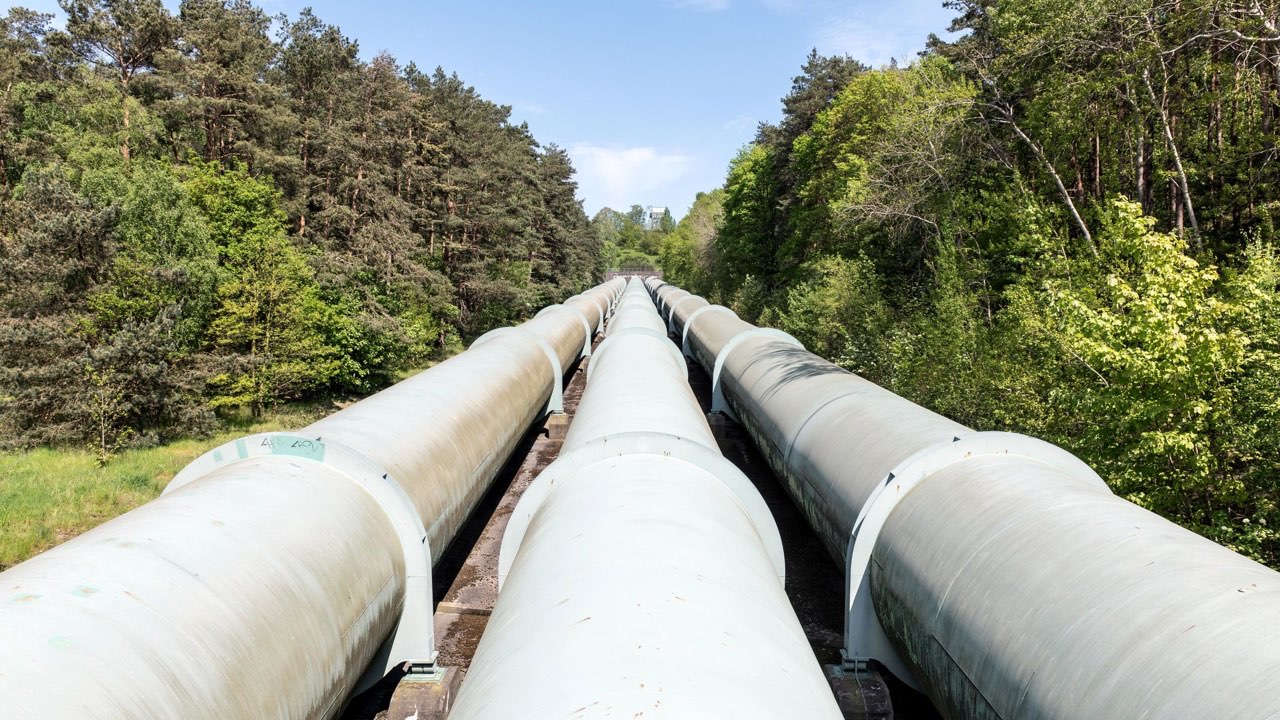
Pull a length of API 5L line pipe and a length of standard black iron pipe off a delivery truck and put them side by side. If both are carbon steel, roughly the same diameter, and neither has been painted or coated, you will have a hard time telling them apart by looking. The color is the same. The weight feels similar. The end treatment may even be identical.
This visual similarity causes real problems on job sites, in warehouses, and in procurement offices where someone assumes that one can substitute for the other in a pinch. It cannot. The two products are manufactured to different standards, tested differently, certified differently, and designed for different applications. Using standard black iron pipe where API line pipe is specified is not a minor deviation — it’s a change in the fundamental specification of the pipeline that can have safety and regulatory consequences.
What Black Iron Pipe Actually Is
“Black iron pipe” is an informal name, not a standard designation. It typically refers to carbon steel pipe manufactured to ASTM A53 (or sometimes A106 for seamless pipe), which covers general-purpose pipe used in plumbing, fire suppression systems, steam and gas distribution at moderate pressures, and structural applications.
ASTM A53 pipe comes in two grades: Grade A and Grade B. Grade B is the more commonly specified, with a minimum yield strength of 35,000 psi and a minimum tensile strength of 60,000 psi. It’s available in both welded (Type E) and seamless (Type S) versions, in schedules from Schedule 10 through Schedule 160 across a range of nominal sizes.
For the applications ASTM A53 was designed to cover — building services, moderate-pressure gas distribution, fire sprinkler mains, general construction — it’s an appropriate and well-characterized product. The standard requires hydrostatic testing of each pipe length, dimensional verification, and a mill certificate documenting the chemical composition and mechanical test results.
What it doesn’t require is much of what API 5L demands for transmission pipeline service.
What API 5L Requires That ASTM A53 Doesn’t
API 5L was developed specifically for oil and gas transmission pipelines — the long-distance, high-pressure lines that move hydrocarbons from production fields to processing facilities and distribution networks. The requirements reflect what that application actually demands.
The first difference is strength. API 5L grades run from X42 (42,000 psi minimum yield) through X80 and beyond, reaching yield strengths that ASTM A53 Grade B doesn’t approach. For a high-pressure transmission line where wall thickness and operating pressure are calculated based on the pipe’s yield strength, the actual yield strength of the material is a critical input. API 5L requires not just that the pipe meet a minimum yield, but that the yield-to-tensile ratio stay within specified limits — because a material that yields very close to its tensile strength behaves differently under overload conditions than one with more ductility.
The second difference is testing scope. API 5L PSL2 (the product specification level required for most transmission pipeline applications) mandates Charpy impact testing to verify the pipe’s toughness at low temperatures, which matters for pipelines in cold climates and for fracture propagation resistance in high-pressure lines. ASTM A53 has no mandatory impact testing requirement.
The third difference is chemistry control. API 5L PSL2 specifies tighter limits on carbon equivalent — a calculated value that reflects how hardenable the steel is and therefore how it behaves during welding. Pipe with high carbon equivalent is more susceptible to heat-affected zone cracking during field welding. Transmission pipelines, which are welded in the field under varying conditions, need material whose weldability is well-controlled. ASTM A53 has chemistry requirements, but they’re less stringent than API 5L PSL2 on the parameters that matter most for field welding.
The fourth difference is nondestructive examination. API 5L PSL2 requires nondestructive examination of the weld seam in welded pipe and of the pipe body — ultrasonic or electromagnetic inspection that looks for laminations, seams, and other discontinuities that hydrostatic testing alone won’t catch. ASTM A53 requires hydrostatic testing but has less extensive NDe requirements.
Why the Substitution Fails in Practice
An API pipe specification guide will tell you that the pipe grade is the basis for pressure calculations. When a pipeline is designed to ASME B31.8 or B31.4 using X52 or X65 pipe, the maximum allowable operating pressure is calculated from that grade’s minimum yield strength and the pipe’s wall thickness. Substituting ASTM A53 Grade B pipe — with a minimum yield of 35,000 psi versus X52’s 52,000 psi minimum — means the actual pressure rating of the installed pipe is lower than the design assumed. The pipeline will be operating above its actual safe pressure limit.
This isn’t a theoretical concern. It’s the reason pipeline operators in most jurisdictions are required to document the pipe specification for every segment of their system and to verify that installed material matches the specification before pressuring up. An inspection that finds Grade B pipe in a segment designed for X52 requires either deration of the operating pressure for that segment (which may not be operationally acceptable) or replacement.
The toughness and chemistry differences matter too, but they’re harder to see in the field. A pipeline with inadequate toughness may perform fine for years before a pressure surge or temperature drop creates conditions where a crack that would have arrested in properly specified pipe propagates instead. At that point, the substitution that seemed harmless becomes a incident investigation.
How to Tell Them Apart When the Material Is Already on Site
The definitive answer is documentation. Every length of API 5L pipe should be accompanied by a mill certificate that identifies the heat number, the applicable standard (API 5L), the grade (X42, X52, X65, etc.), the PSL, and the chemical and mechanical test results for the heat. Every pipe length should have a stenciled marking that includes the manufacturer’s name, the applicable standard, the grade, and the size. API 5L specifies exactly what markings are required and where they must appear.
ASTM A53 pipe also has required markings, but they reference ASTM A53 and Grade A or Grade B rather than API 5L and an X-grade. If you’re looking at a pipe length and the stenciling says “A53 GR B” rather than “API 5L X52 PSL2,” you’re looking at a different product.
The problem on job sites is that pipe sometimes arrives without legible markings — stenciling fades, pipe gets cut and the marked section discarded, material gets commingled in a yard before the project starts. In those situations, the only reliable verification is tracing the material back to documented mill certificates and matching heat numbers to the physical pipe. Visual inspection alone cannot confirm that pipe is API 5L versus ASTM A53.
The Procurement Implication
The practical takeaway for procurement is that specifying API line pipe and specifying black iron pipe are not interchangeable requests, and a supplier who quotes one when asked for the other is not providing an equivalent product. The price difference between API 5L PSL2 and ASTM A53 Grade B reflects genuine differences in testing, chemistry, and performance — not just a label.
On a project where the specification calls for API 5L, the purchase order needs to say API 5L, the grade, and the PSL. A purchase order that says “carbon steel pipe” or “black pipe” leaves room for the supplier to ship the cheaper product, and the cheaper product may not be what the design requires.